Sound Production: Airflow

Bellows Pressure
The airflow in a concertina is generated by expanding and contracting the bellows. The amount of air pressure generated is determined by the player. The more force the player applies to the bellows, the higher the air pressure. The size of the bellows also play a role in the amount of pressure that can be generated.
If the same amount of force (F) is applied by the player, smaller bellows will generate more air pressure than large bellows. Pressure is the force applied by the player, divided by the size of the bellows: P = F : S. This formula illustrates that the pressure generated on a concertina is much greater than on a full size accordion. That’s why we call concertinas high pressure and accordions low pressure free reed instruments.
If the same amount of force (F) is applied by the player, smaller bellows will generate more air pressure than large bellows. Pressure is the force applied by the player, divided by the size of the bellows: P = F : S. This formula illustrates that the pressure generated on a concertina is much greater than on a full size accordion. That’s why we call concertinas high pressure and accordions low pressure free reed instruments.
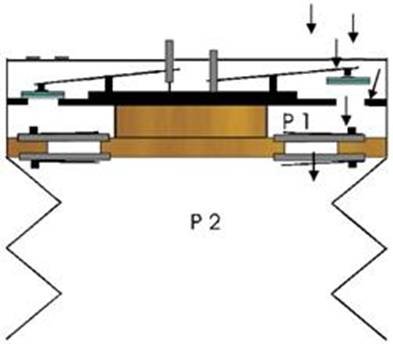
airflow direction by expanding bellows
The airflow In a concertina is initiated by pushing down a key and expanding or contracting the bellows at the same time . The key is connected to a pad which opens the airhole of a reed chamber. Every reed chamber in a concertina contains two reeds, one for each bellows direction. On English and Duet concertinas, these two reeds are the same pitch, on Anglo concertinas they have a different pitch.
When the bellows are expanded (pulled) it creates an airflow which passes through the selected air hole into the reed chamber. On the opposite side of the air hole is an oblong opening, called a reed slot, over which the reed is placed . The airflow exits the chamber through this slot, and activates the reed. The reed that is activated when the bellow are extended (pull), is mounted on the chamber floor, inside the reed chamber. The reed that is activated when the bellows are contracted (push) is mounted on the chamber floor outside of the chamber.
The reed obstruction creates a higher air pressure (P1) in the chamber and a lower pressure (P2) outside the chamber. This pressure difference is needed to initiate and maintain reed oscillation.
When the bellows are contracted (pushed), the reed mounted outside the chamber is activated. The air flows in the opposite direction, from the bellows through the reed slot into the chamber and exiting through the airhole. P1 and P2 are now reversed.
When the bellows are expanded (pulled) it creates an airflow which passes through the selected air hole into the reed chamber. On the opposite side of the air hole is an oblong opening, called a reed slot, over which the reed is placed . The airflow exits the chamber through this slot, and activates the reed. The reed that is activated when the bellow are extended (pull), is mounted on the chamber floor, inside the reed chamber. The reed that is activated when the bellows are contracted (push) is mounted on the chamber floor outside of the chamber.
The reed obstruction creates a higher air pressure (P1) in the chamber and a lower pressure (P2) outside the chamber. This pressure difference is needed to initiate and maintain reed oscillation.
When the bellows are contracted (pushed), the reed mounted outside the chamber is activated. The air flows in the opposite direction, from the bellows through the reed slot into the chamber and exiting through the airhole. P1 and P2 are now reversed.
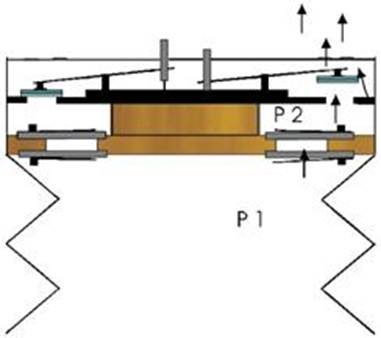
airflow by contracting bellows
Valves
Concertina valves close off the reed slot in the reed chamber of the reed that is not activated. E.g., when the 'pull' reed is activated, a valve closes off the 'push' reed slot, and visa versa. Valves are made out of leather (hair-sheep, sheep, or goat leather), or Mylar.
Valves are opened and closed by the airflow. The closing function is straight forward; the airflow pushes the valve against the chamber floor and prevents air from passing through the reed slot.
The opening function is more complicated. The airflow to the activated reed will be lifted off the chamber floor by the aiflow.
, they will always to allow maximum When a valve is placed in the airflow, it will always create an obstruction. Valve obstruction is caused by the resistance of the leather (stiffness) and mass. The obstruction affects several aspects:
Pitch, valve resistance can lower the pitch of a reed by several cents.
Reed attack, the amount of resistance affects the initial airflow and therefore the time it takes for the reed to start sounding.
Reed coasting at low volume. High valve resistance increases the minimum airflow requirement for a reed to coast. Ideally, the valve resistance value should be lower than the airflow value needed for the reed’s coasting. This is one issue that is frequently found on instruments revalved by someone without the necessary knowledge.
Valves also add variables that are not fully controllable:
Over time the leather will become suppler, which reduces the amount of resistance. This affects the pitch of the reed.
When valves age, they loose strength and do not close fully. This is called valve leakage, and affects the reed attack.
Because different reed sizes have different airflow values -large reeds have more airflow than small reeds-, valves need to be adjusted to match the airflow values. This is done by adjusting the thickness and resistance of the valves.
With an Airflow velocity meter the airflow is measured before and after a valve is installed. The objective is to create a uniform airflow pattern.
Valves are opened and closed by the airflow. The closing function is straight forward; the airflow pushes the valve against the chamber floor and prevents air from passing through the reed slot.
The opening function is more complicated. The airflow to the activated reed will be lifted off the chamber floor by the aiflow.
, they will always to allow maximum When a valve is placed in the airflow, it will always create an obstruction. Valve obstruction is caused by the resistance of the leather (stiffness) and mass. The obstruction affects several aspects:
Pitch, valve resistance can lower the pitch of a reed by several cents.
Reed attack, the amount of resistance affects the initial airflow and therefore the time it takes for the reed to start sounding.
Reed coasting at low volume. High valve resistance increases the minimum airflow requirement for a reed to coast. Ideally, the valve resistance value should be lower than the airflow value needed for the reed’s coasting. This is one issue that is frequently found on instruments revalved by someone without the necessary knowledge.
Valves also add variables that are not fully controllable:
Over time the leather will become suppler, which reduces the amount of resistance. This affects the pitch of the reed.
When valves age, they loose strength and do not close fully. This is called valve leakage, and affects the reed attack.
Because different reed sizes have different airflow values -large reeds have more airflow than small reeds-, valves need to be adjusted to match the airflow values. This is done by adjusting the thickness and resistance of the valves.
With an Airflow velocity meter the airflow is measured before and after a valve is installed. The objective is to create a uniform airflow pattern.
Pads and Airholes
The amount of air that can enter the reed chamber is determined by the size of the air hole and the air pressure. It is obvious that larger reeds with larger chambers need large air holes to accommodate the higher airflow requirements. Small reeds (high pitch) only need small chambers and air holes. The scaling of the air hole sizes can easily be calculated.
Basic design vintage concertinas often have only one size air hole for every reed size in the instrument, which often results in uneven reed performance.
The pads that close off the air holes also have an effect on the airflow. They need to open far enough to not interfere with the airflow. The limited space in the action cavity determines the thickness of the pads and the type of connection to the lever.
Setting up an action follows the following chain of decisions:
-The airflow value needed determines the required pad lift.
- the pad lift and available space determines the type of pad and lever connection.
- The total pad lift movement determines the key travel (how far the key needs to be
depressed). The button guide pin often is a limiting factor, and may prevent the necessary
button travel..
- The pad/hole overlap and the maximum air pressure on the pad determines the type of
pad leather and the type of springs needed and their pressure. This is the key pressure which
is measured in grams.
Traditional brass springs can not be calibrated accurately. Their adjustment usually in in 10 grams intervals. Another issue is that they tend to lose their tension over time. High density steel springs are much more accurate. They can be adjusted in 1-2 gram intervals, and will keep their tension for many years.
The process of ‘setting up’ an action is called calibrating. Although essential for maximum performance, it is rare to find a correctly calibrated action in a concertina. It requires besides a lot of knowledge also specialized equipment to measure airflow, pressure, valve resistance, etc.. With all this information it is possible to make the correct parts (valves, pads, and springs) for an instrument.
Basic design vintage concertinas often have only one size air hole for every reed size in the instrument, which often results in uneven reed performance.
The pads that close off the air holes also have an effect on the airflow. They need to open far enough to not interfere with the airflow. The limited space in the action cavity determines the thickness of the pads and the type of connection to the lever.
Setting up an action follows the following chain of decisions:
-The airflow value needed determines the required pad lift.
- the pad lift and available space determines the type of pad and lever connection.
- The total pad lift movement determines the key travel (how far the key needs to be
depressed). The button guide pin often is a limiting factor, and may prevent the necessary
button travel..
- The pad/hole overlap and the maximum air pressure on the pad determines the type of
pad leather and the type of springs needed and their pressure. This is the key pressure which
is measured in grams.
Traditional brass springs can not be calibrated accurately. Their adjustment usually in in 10 grams intervals. Another issue is that they tend to lose their tension over time. High density steel springs are much more accurate. They can be adjusted in 1-2 gram intervals, and will keep their tension for many years.
The process of ‘setting up’ an action is called calibrating. Although essential for maximum performance, it is rare to find a correctly calibrated action in a concertina. It requires besides a lot of knowledge also specialized equipment to measure airflow, pressure, valve resistance, etc.. With all this information it is possible to make the correct parts (valves, pads, and springs) for an instrument.


